

Why Mobile Optimisation Matters for B2B in 2026
Not long ago, most B2B research happened on desktops in offices during working hours.
Today, that picture looks very different. Decision makers are just as likely to read industry insights on their phones during a commute, review vendor websites between meetings, or download resources while travelling. The buying journey has become more mobile and far less predictable.
For organisations focused on demand generation, this shift creates both an opportunity and a risk. A well-designed mobile experience can capture attention and encourage engagement at the exact moment a prospect is researching solutions. A poor experience can cause potential leads to leave before they even explore what you offer.
In 2026, mobile optimisation has become a critical part of how organisations engage and convert B2B buyers.
Start with Strong Mobile Performance
A strong mobile experience begins with technical performance. Your website must load quickly, operate securely, and function consistently across different devices.
Page speed continues to be one of the most important factors. If a page takes too long to load on a smartphone, visitors often leave before interacting with the content. A loading time of under three seconds remains the recommended benchmark.
Several technical foundations play an important role in supporting a strong mobile experience:
- Fast page loading speeds that reduce bounce rates
- Responsive layouts that adapt to different screen sizes
- Optimised images and media that balance quality with performance
- Secure browsing environments that build user trust
- Mobile-friendly pop-ups that do not disrupt the experience
Regular testing across multiple devices and browsers is also important. Mobile behaviour changes quickly, and ongoing monitoring helps ensure issues are identified early.
Design a Mobile Experience That Is Easy to Navigate
Technical performance alone does not guarantee engagement. Visitors must also find the experience intuitive and easy to navigate.
Mobile users interact with websites differently from desktop users. Most navigation happens using thumbs, which means menus, links, and buttons should be large enough to tap comfortably. Layouts should remain clean and structured so users can quickly locate information without unnecessary scrolling.
Jakob’s Law provides a helpful principle here. It suggests that users prefer websites that behave in familiar ways. When navigation and layout follow common design patterns, visitors are more likely to move through the experience smoothly.
Readability also plays an important role. Text must remain easy to read on smaller screens. Designers often recommend a minimum font size of sixteen pixels combined with strong contrast between text and background. Accessibility standards such as WCAG provide valuable guidance for ensuring content remains readable across devices.
Call-to-action buttons should remain visible as users scroll so that visitors can easily take action when they are ready.
Make It Easy for Mobile Visitors to Convert
Once visitors engage with your mobile content, the next step is making it easy for them to convert.
Actions such as completing forms or downloading resources must work seamlessly on mobile devices. If the process feels slow or complicated, users may abandon the page before finishing the action.
Clear value propositions help capture attention quickly. Mobile visitors often skim content, so communicating the value of your offer early can significantly improve engagement.
Several design considerations can help make lead capture more effective on mobile:
- Simple forms with large input fields that are easy to tap
- Autofill functionality that reduces the amount of typing required
- Direct contact options such as click-to-call or chat tools
- Landing pages designed specifically for mobile users
- Downloadable resources that load quickly and are easy to read on phones
When the value of the content is clear and the process is simple, visitors are far more likely to share their information.
Continuously Improve Mobile Conversion Performance
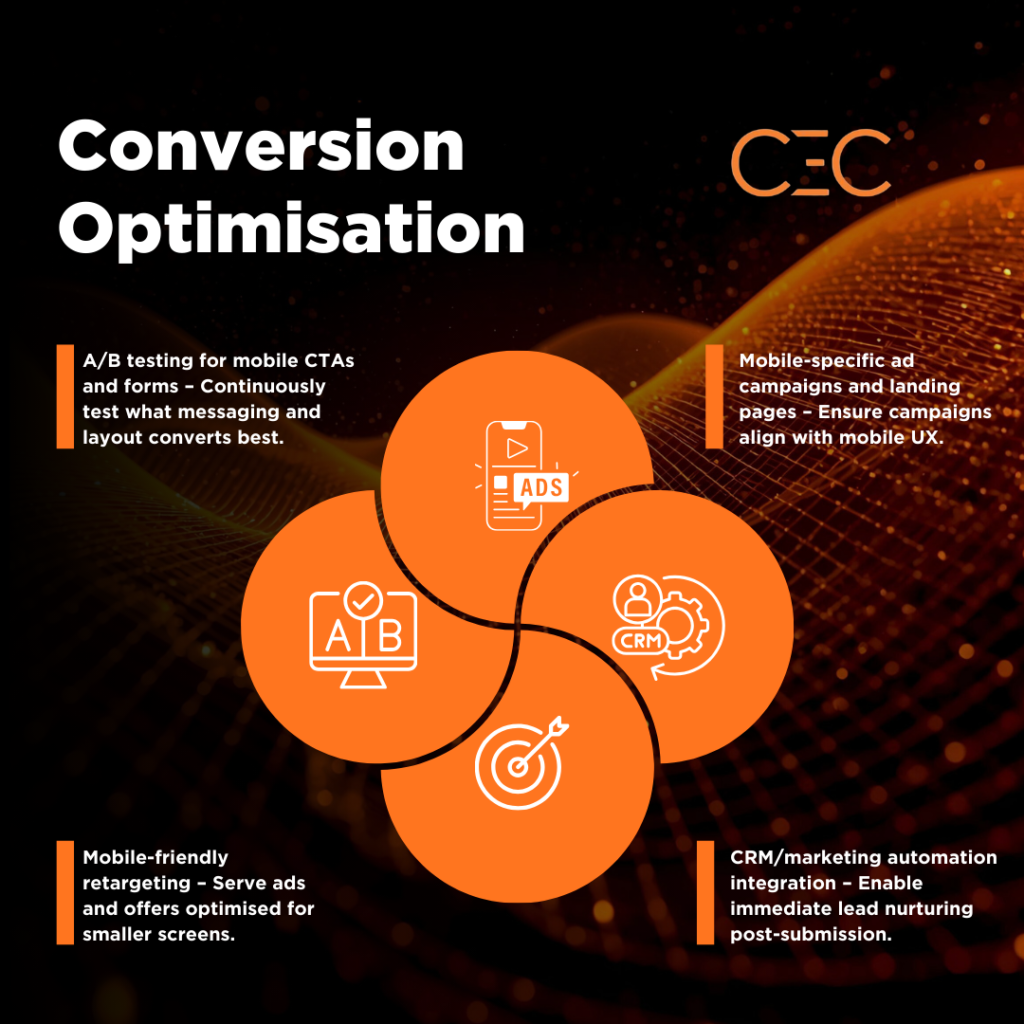
Improving mobile lead generation is not a one-time exercise. It requires continuous testing and refinement.
Small adjustments to page layouts, messaging, or form design can significantly influence conversion performance. Organisations that monitor user behaviour and regularly experiment with improvements often discover opportunities to reduce friction and increase engagement.
Over time, this process of testing and optimisation helps organisations build mobile experiences that consistently convert visitors into qualified leads.
Ensure Your Mobile Experience Is Discoverable and Measurable
Even the best mobile experience will struggle to generate results if users cannot easily find the page.
Search engines increasingly prioritise mobile usability, making mobile optimisation an important factor for search visibility. Websites should pass Google’s mobile-friendly test to ensure that pages perform correctly on smartphones and tablets.
Core Web Vitals also remain an important ranking signal. Metrics such as Largest Contentful Paint, First Input Delay, and Cumulative Layout Shift measure how smoothly a page loads and responds on mobile devices.
Accurate analytics is equally important. Platforms such as Google Analytics 4 allow organisations to track mobile engagement, understand user behaviour, and measure conversions across devices. Tracking parameters such as UTM tags also help marketers understand which campaigns and channels are generating leads.
Building a Mobile Strategy That Supports Demand Generation
Mobile experiences now play a central role in B2B demand generation. Organisations that prioritise fast performance, intuitive design, and measurable engagement are better positioned to convert mobile visitors into qualified opportunities.
To support this process, we have created a downloadable framework that helps teams review and optimise their mobile presence step by step.